Cybersecurity & POPIA protection built for South African medical practices
Find the gaps in your staff, WhatsApp, email, patient-data and incident-response processes before they become a breach, fraud loss or regulatory problem.
No technical knowledge needed. No obligation. 20 minutes.

Problem Recognition
Does any of this happen in your practice?
These aren't hypothetical. They're the everyday situations we hear from South African medical practices — and each one is a quiet gap waiting to become an incident.
The WhatsApp result leak
A patient's pathology result is sent to the wrong WhatsApp number. Who told the patient? Who told the regulator?
The Downloads folder
Copies of patient IDs sit in the shared reception computer's Downloads folder — visible to every staff member and locum.
The supplier banking change
An email arrives asking you to update a supplier's banking details. Your staff pay R140,000 into the wrong account.
The shared password
The whole reception logs in with one password. Nobody knows who accessed what — or when.
The untested backup
Backups run every night. Nobody has ever restored one. When you need it, will it actually work?
The first 30 minutes of silence
A breach happens. Nobody is certain who does what, who calls the regulator, or who tells the affected patients.
Free 20-Minute HDS Diagnostic
A practical review of your practice's operational exposure — in 20 minutes
No technical knowledge needed. No obligation. We walk through the everyday areas where practices quietly accumulate risk — staff behaviour, email, WhatsApp, patient information, account access, supplier fraud, backups and incident response.
20 minutes, on a call
A focused conversation, not a sales pitch. You don't need to prepare anything.
Clear priority risks
You leave with a plain-language picture of where your practice is most exposed operationally.
No obligation
If there's a fit, we'll suggest next steps. If not, you still leave with useful insight.
What will I leave with?
By the end of the 20 minutes, you'll understand three things:
- 1
Your largest operational risk
The one gap most likely to cause a breach, fraud loss or complaint in your specific practice.
- 2
The control that should be fixed first
A single, practical priority — not a 40-page report.
- 3
The appropriate next step
Whether that's working with us, handling it internally, or something else entirely.
Three Service Pillars
Built around how your practice actually works
CyberSec Resilient isn't an IT support company. We focus on the operational, human and governance side of cybersecurity — the part most practices never get to.

Pillar 01
Human Firewall
Make your staff harder to fool.
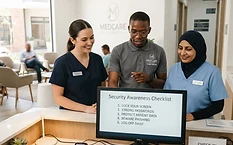
Practical awareness training built around the real scenarios your reception and admin staff face every day — phishing, WhatsApp, passwords, payment fraud. Not a generic video module.
- Phishing simulations with real SA healthcare examples
- WhatsApp & email handling rules staff remember
- Payment verification call-back SOPs


Pillar 02
POPIA Operational Readiness
Move POPIA from documents into daily operations.
POPIA compliance that lives in your practice's daily routines — not a binder on a shelf. We translate the Act into controls your staff can actually follow and your Information Officer can maintain.
- Information Officer practical guidance
- Operator & data-processing agreements
- Patient data handling procedures


Pillar 03
Incident Readiness
Know exactly what happens in the first 30 minutes.
A calm, rehearsed response plan so a breach or fraud attempt doesn't become chaos. We build the playbook, assign the roles, and walk your team through it before you need it.
- First-30-minutes response playbook
- Role assignment & escalation paths
- Regulator & patient communication templates
Healthcare Specialisation
Cybersecurity looks different inside a medical practice
A medical practice isn't a generic office. It runs on specific systems, handles deeply personal information, and depends on staff who are often stretched thin. Generic cybersecurity advice doesn't fit. We work inside the real workflows of South African healthcare.
See our healthcare expertise

How CyberSec Resilient Works
Four steps. No jargon. No chaos.
Step 1
Discover
We map your practice's real operational workflows and find where risk quietly accumulates.
Step 2
Prioritise
We rank risks by likelihood and impact so you fix what matters first — not everything at once.
Step 3
Fix
We build practical controls your staff can actually follow — in their language, in their routine.
Step 4
Prove
We document what's in place so you can demonstrate reasonable steps to a regulator or insurer.
Trust & Proof
Credentials, experience and evidence
A cybersecurity brand must earn trust with verifiable facts — never invented ones. These are the qualifications and certifications behind CyberSec Resilient.
Certifications & qualifications
- MBA — Master of Business Administration, University of South Africa (UNISA)
- ISO 22301 Lead Implementer — Business Continuity Management
- PECB Certified — Professional Evaluation & Certification Board
- ITIL Certified — IT Service Management
- IT Governance & GRC Leader — Governance, Risk & Compliance
- DR/BCP Expert — Disaster Recovery & Business Continuity Planning
Client outcomes
Coming soon — real, verifiable outcomes from engagements, shared with client permission.
Speaking & publications
Coming soon — speaking engagements, webinars and published educational resources.
Our trust rule: we never fabricate testimonials, client names, logos, certifications, statistics, awards or partnerships. Everything here is confirmed and verifiable.
Risk Pulse — Featured Insights
Practical intelligence for South African healthcare
Operational controls, POPIA guidance and incident-readiness thinking for South African medical practices.

The Downloads Folder Data Leak: The Patient Records Your Practice Forgot
Every ID copy, every result, every referral that lands in a shared Downloads folder is a quiet data breach waiting to be found.
Read article

Can a Medical Practice Send Patient Results Through WhatsApp?
It's convenient, patients expect it, and it's one of the most common POPIA risks in South African practices. Here's what to consider.
Read article

Your Doctor's Voice Can Be Cloned. The Payment Rule That Stops the Fraud.
AI voice impersonation means a fraudulent payment instruction can now arrive in your doctor's actual voice. One rule stops it.
Read articleFree Resource
The Payment Verification Call-Back SOP
Supplier banking-detail fraud is one of the most common financial losses in South African practices — and one of the easiest to stop. This one-page SOP gives your staff a simple call-back rule that prevents it.
- One page your staff can follow without training
- Works for any supplier or billing bureau payment
- Reduces your single largest fraud risk to near zero
Enter your details to download. We'll never ask for patient information.
FAQ
Before you book
Find the gap before an attacker, fraudster or complaint does.
Book your free 20-minute HDS Diagnostic. No technical knowledge needed. No obligation.